
2026-08-18-Why Q Needs U By Danny Bate
ISBN: 978-1785307430
August 18, 2026
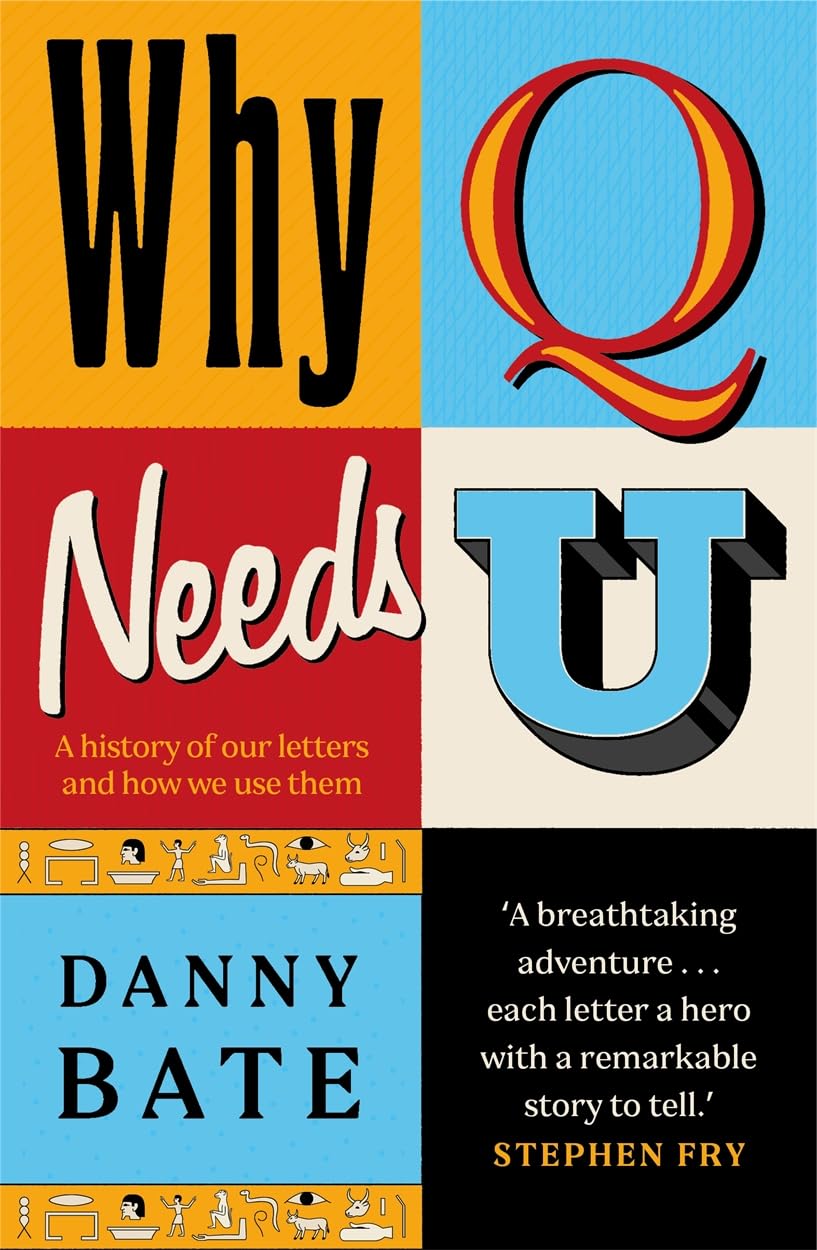
If you want to tell the history of the alphabet the first thing you must decide is which alphabet it is that you want to tell the history of. Then, you must decide which culture best tells that history. Mr. Bate in Why Q Needs U tries to straddle the line. We often find ourselves back in Rome, or Egypt, or Israel. Often, we are introduced to the Phoenicians. While Mr. Bate is careful not to take a side concerning where the alphabet began, many of his unsolvable mysteries neatly resolve themselves if one makes the assumption that Israel, or the Semitic alphabet, is the point of origin and from there many other countries have taken and modified those essentials for their varying ends and needs.
A central debate that Mr. Bate is careful to point out centers on whether spelling should be by form or by sound. In other words, should spelling be governed more by convention, or more by what the ear hears? There are arguments to be made on both sides—either for preservation of the root and history of the word or for the ease of use that being able to sound out a word could impute concerning the necessary "correct" spelling. For instance, when one spells the word "dog" one does not spell it "dawg"—except maybe in some slang derivations. The second spelling looks more like how the word sounds whereas the first does not really show the way the word sounds without knowing the rule that it is pronounced with a certain kind of "o" sound.
The headliner letter, namely Q and why it needs U, is probably the letter that Mr. Bate likes least in that it seems he is always arguing that it really should not be there except for those pesky Romans who kept it around and then various tribes that held on to it and re-introduced it. The reason the U has to follow it is because, in short, the sound for Q and K were often mixed up, and the sounds for QU were specific and unique enough to warrant keeping the Q in the box of necessary phonemes or sounds.
We learn that the Semitic Vav turned into a bunch of other letters, like F, V, U, W, and Y. I guess the "tent peg" of the vav must have had all those other letters in the tent, although one wonders whether it was not a circus with some Shriner cars. We also explore a lot of alternative spellings from things in Middle English that only appear vaguely recognizable and are later mixed with German and French with some Norse thrown in for good measure. The English that preceded is not "leet" enough, and so the new language turns into a kind of odd amalgamation of these languages for perceived "prestige." This coincides roughly with William the Conqueror taking the throne and causing a perception shift in the relative "specialness" of the new languages being spoken in court.
Often times, when one is reading any book about linguistics, it is hard to make sure the notation is matched in the reader's mind to the actual sound it implies. There is a kind of special coding that linguists use in order to show the kind of accents that are present when a person is speaking, and some of that lightly makes its way into the book. If one happens not to be a linguist, one has to remind one's self about what sound a given indicated symbol is supposed to represent. There is a glossary present of terms, but it is sadly bereft of phonemes and their notations.
The sharpest criticism one can level, though, is that it feels like Mr. Bate is trying to play it safe in the political realms with many of his examples and lack of commitment to what he considers to be the oldest alphabet. He tries to keep the letters up front, but one can catch whiffs of PC kinds of thinking from time to time as though the publisher nudged him to include an Islamic quote or a Christian quip. This lack of strong belief in terms of origins keeps Mr. Bate guessing as to why the alphabet ended in a Tav for so long. He notes only that the reason for alphabets doing this was lost to the mists of time. It is not to people that speak Hebrew, though. Since the Messiah was hanged on a cross or a Tav, it was a harbinger of the end and a sign of the plan of redemption. It is little wonder, then, that Rome and Egypt wanted to muddy those waters. Such obfuscation could allow one to think of Caesar as always being and never ceasing. An especially piquant reminder of Rome's foibles would be to show everyone that the fella they decided to execute on the cross is also the last letter of our alphabet in the sense that it is a cross. A Roman citizen would be especially familiar with a crucifixion. Egypt, on the other hand, was keen to tie in Y-like characters as a representation of a desert viper. Why? Probably because Egypt wanted to be powerful and cool. That Tav there at the end, that simply would not do. So, the penalty for playing it safe is less explanatory power. Of course, this explanation requires the belief that Noah was the progenitor of all the people living on the Earth which is definitely not academically in vogue.
This absence, though, makes the book sometimes hard to read because one is having to read about the "theory" of why a certain letter is a certain way when the Hebrew makes it perfectly clear WHY it is that way. It could be no other way, and some of the explanation that follows is a little like a Scooby Doo episode where every ghost is just Mr. Biggs who is wearing a prosthetic mask because he hates those "meddlin' kids."
That's not to say, though, that the book is bad. If anything, the thorough scholarship keeps one interested enough to outweigh the annoyance of slogging through "what-ifs". One can learn much about how words have changed over time, and how F's and W's and all manner of other exotic sounds crisscrossed as everyone colluded to try to figure out how to spell what they were saying. Also, they were trying to figure out how to say what they were saying. Letters were emphasized and disappeared whereas others made themselves guests to a given word party and then later became permanent fixtures. Vowels were shortened and elongated and sometimes dropped. It is, to say the least, a fascinating thing to watch from a distance and worth a read for the long perspective such analysis provides.