
2026-06-26-Elon Musk by Walter Isaacson
June 26, 2026
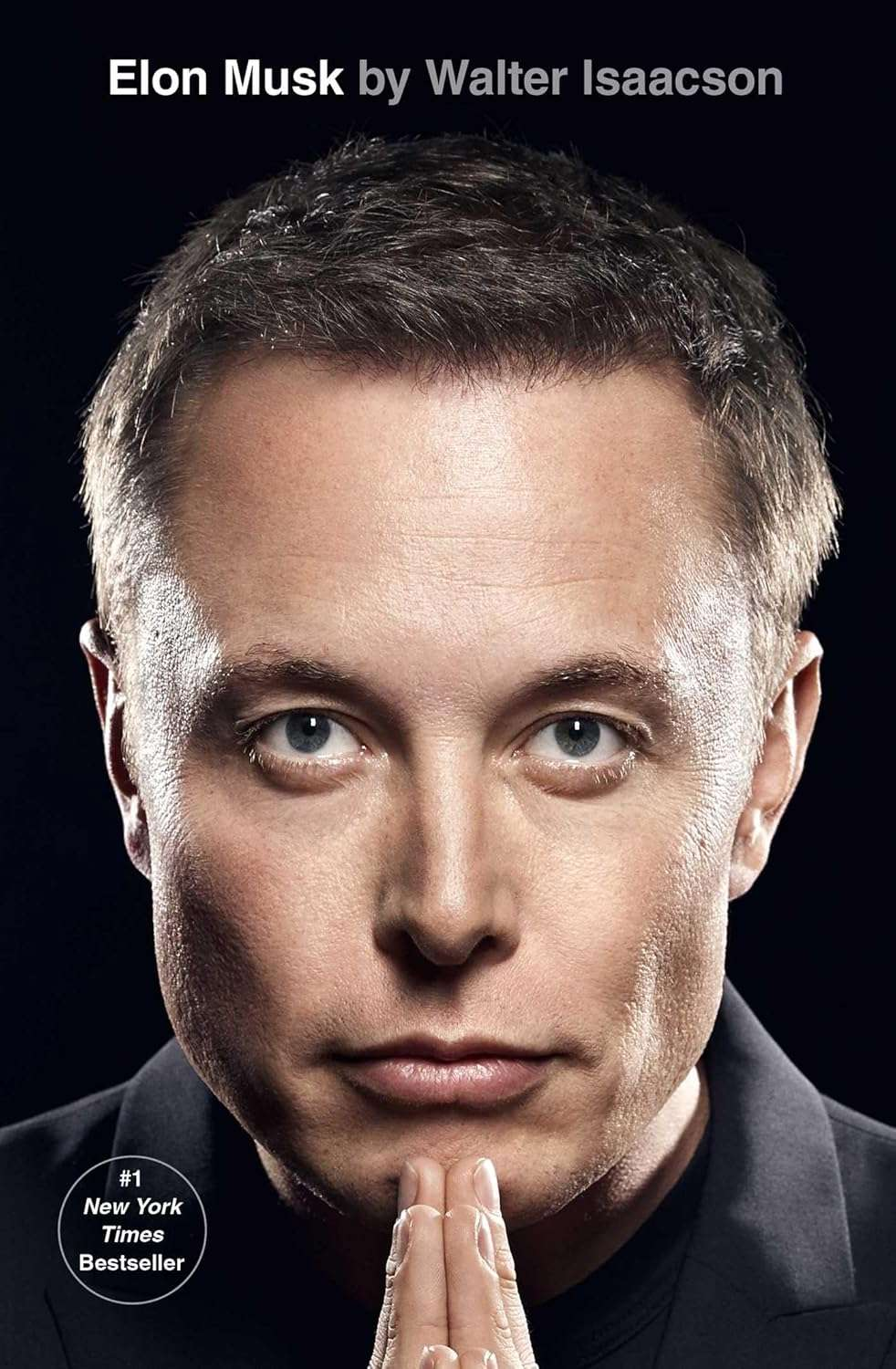
They say you should not judge a book by its cover. Elon Musk's biography, Elon Musk, has a picture on the front that one would consider to be a rich-tech-douche-with-too-high of an opinion of himself template. The aura is positively a Steve Jobs level of PR sophistication and conceit.
On the other hand, when you open the book and read about Elon Musk and his life, you can quickly forget the hands posed in a quasi-prayer at the chin meant to emphasize the straight line of the nose against the face, and carefully brushed lighting. It is, one begins to reason, a kind of glamour that the world requires of the extravagantly wealthy.
By the time one finds Elon having to step through the blood of a recently murdered individual in South Africa during a childhood excursion, the tone and tenor take on something else still. His father's need to push the boundaries of truth and toughness are another quality that seeps into the reader's experience of the account of his life, and soon one is feeling sympathetic to Mr. Musk. The reason Mr. Musk is a tech visionary is owing to this ability to push reality to a point of belief and self-editing where what seems to be impossible becomes the new normal. Errol Musk, if nothing else, impresses upon Elon this propensity for belief that hovers between miracle and con. Errol probably falls more to the con side of the scale, whereas Elon goes on to do other great things—most often with his brothers or family being involved in bursts and intervals.
Musk's mother is another entity entirely, and eventually gets tired of putting up with Errol, and so leaves him, and that creates a lot of tension between where Elon is and which parent he is seeking company with. Eventually, the desire to be around Errol dries up, as the stability of his mother's way of living gradually wins more favor. This by no means means that Elon starts to live a more average life. He begins to strike out early on his own to get to school and eventually to get to college and ultimately to start his own businesses where most often, he sleeps on floors or under desks—a habit he continues to the present day—particularly when there are deadlines looming. When he is not on a floor or under a desk, he could often be found on a friend's couch. Eventually, though, he buys big houses, sells them out of a kind of rich guilt, buys smaller houses, and lives in an average manner so long as the deadlines for his companies are not looming.
Should one of those deadlines approach, the book takes careful pains to talk about his other mode of being that they refer to as "demon mode", where often Elon is styled as making brutal decisions in terms of rapidly firing someone or "deleting" what hitherto was considered to be a crucial component on a model rocket or satellite. He takes a lot of risks. Indeed, he might be addicted to risk in a similar way his father was. His string of marriages and children prove how quickly he gets into life changing scenarios and then just as quickly has to leave them. Most often, it is because ambition has triumphed over his personal life. First and foremost, he is dedicated to his businesses which he sees as being concerned with improving the human condition. Space X existed originally because Elon believed humanity was going to screw the Earth up so bad they better have Mars as a back up place to live.
Still, despite all this drive and talk of "demon mode" there is another aspect to Musk where he will suddenly be joking and laughing almost as quickly as he was contemplating firing someone. For deeper decisions he tends to withdrawal, and to pepper people with questions that most feel is like an attack. Elon's staff often warn the unwary about this tendency. Some say it is autistic, some say it has to do with not having had a lot of emotional nurturing in his childhood. Most probably, it has to do with Elon's tendency to live in his own head.
There is a lot of discussion about supply chain logic, self-fabrication, industrial know-how, and absolute fumbles in having taken risks that did not become advantage. The book would seem incomplete without these foibles and victories being presented. In some sense, they are somewhat boring to read in that they are not so much about Elon Musk as much as they are about how Elon Musk works in the early 21st century in the world of business.
What stands out is that Musk seems to genuinely believe what he is doing is the best for humanity, and becomes confounded and confused when presented with people who have other motives that are not consistent with that end. The Tesla electric cars, for instance, were a major focus for Musk to get humanity away from dependence on fossil fuels. Self-driving cars, he thinks, will reduce risk and increase efficiency. The brain implant chips can help people who have no motor control walk and speak. He seems to see the positive side of these advancements while ignoring the potential negative applications.
His biggest blind spot, though, is in using AI on his X site and automatically concluding that all the human data on there is HIS to do with as he will for training AI or self-driving Tesla cars. How does an idealist for what is right for humanity conclude that all of its data is put to best use in companies that one owns for immense profit? The ego comes out. Musk on some level must believe he is smarter or more equipped to make these decisions and if you happen not to like it, just get off of X. Fine. Why have X if a choice for how the content you put there as a human is going to be utilized is non-existent? If a hypothetical person owned say, a huge space rocket company, and everybody who wanted to have a rocket company had to frequent this big monopoly, would Mr. Musk be okay with having Space X's data used by the bigger company for its financial ends with no compensation? Probably not. Knowing the character of Musk in this book, definitely not.
Despite all his flaws, though, Elon Musk emerges from the pages of this book about his life as rather likable and somewhat of a tragic figure. While it is clear he is intelligent, it seems like he spends most of his time on projects that can be easily dashed in the long running saga of humanity. Electric cars, for instance, are only useful if they have batteries and batteries rely on rare earths to be made. Is it a better switch from relatively scarce fossil fuels to extremely scarce rare earth materials? The trade is likely a poor one. The same can be said of solar roofs and even rockets. It might behoove us to learn to live on the planet we have before we try to go to one that does not automatically welcome us as a guest.
One suspects that despite all of Musk's accomplishments, he still really has not hit on his legacy. Sure, he is basically now a kind of independent NASA. Yeah, he has a bunch of satellites and clearances for military contracts. He can supply internet connectivity to entire war-torn countries. But, so what? With a trillion dollars, one suspects the metric becomes what one did NOT do versus what one does. What is being neglected so that rockets can be launched? Is it a worthwhile trade-off? Is running X/twitter an actual useful human good, or just adding a lot of noise to an all ready messy signal? Do algorithms add to the discussion, or make people content farm?
Put differently, the childhood question of "If you had all the money in the world what would you do?" is exactly the question Elon has to answer. One should hope that his idea of human good is advanced and actually IS good as opposed to something he simply believes to be good.