
2026-06-28-Body of Secrets by James Bamford

June 28, 2026
Funny thing about James Bamford. He is seemingly everywhere for some time, then disappears from off the face of the Earth. An example review from the period might prove illustrative:
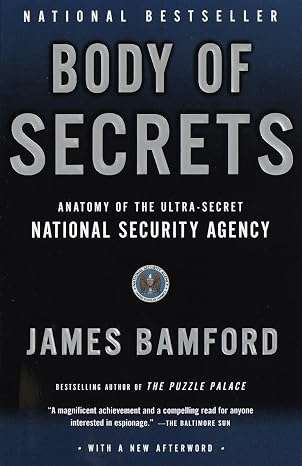
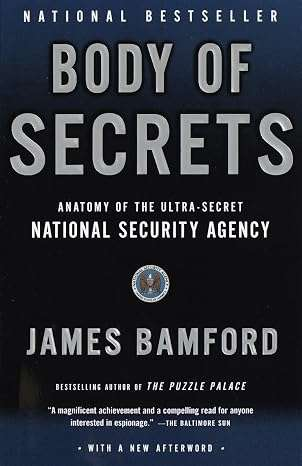
> Body of Secrets. Anatomy of the Ultra-Secret National Security Agency.
> by James Bamford.
> Doubleday 2001. 721 pages. Index, Three Appendices and Endnotes. $29.95 Hardcover. ISBN 0-385-49907-8 LoC UB256.U6 B36 2001
> Reviewed by Robert Bruen May 27, 2001
> The author of the Puzzle Palace (1983) has managed to get significant access to the National Security Agency (NSA) and its documents. Although it is very likely that some material remains hidden, what has been uncovered is astonishing. This is a major history of what was once called No Such Agency because of the level of secrecy it maintained. Like the other three letter agencies, there are many blunders that accompany the many successes, all covered in great detail. Much of it brings back memories that one would just as soon forget, if that were possible. For example the role of the NSA in the Vietnam War is documented from the first casualty, an NSA sigint specialist named James Davis, to the horrific scenes of the final minutes of evacuation from Saigon by American helicopters.
> The book is revealing, filling in gaps of knowledge for those of us old enough to have lived through much of NSA's history. It helps with the suspicions that something else was going on, beyond what was publicly known. NSA is generally thought of as the crypto guys, making and breaking codes, gathering intelligence for the security of the USA, but the technology we have today is of recent vintage. Before satellites and the Net, signals were captured the old fashion way: spy planes, spy ships, and spy people. Some of these spies got into real trouble, for example Gary Powers, when his U2 plane was shot down over the USSR in 1960. The news story was very public, except that no one acknowledged that President Dwight D. Eisenhower gave the order to send the U2 on its mission until now. More than one official lied to Congress to cover up that fact.
> There are several other painful stories which are now more complete thanks to Bamford, such as the capture of the Pueblo by North Korea in 1968 and the failed Bay of Pigs invasion of Cuba. The one operation that is the scariest of all, which fortunately was not executed, was Operation Northwoods, drawn up around the end of Eisenhower's administration and the beginning of John F. Kennedy's term in office. The plan was signed by all members of the Joint Chiefs of Staff. It called for a series of staged execution of Americans on the streets, bombings in Washington DC, and the sinking of boats full of Cuban refugees. Innocent people would be framed for the crimes with the intention of blaming it all on Fidel Castro to sway the American public to support an invasion of Cuba. Much of this book reads like fiction, but as they say: who could make up this stuff?
> To be fair, the NSA has had successes which should be noted. The are well known for their crypto advances. Bamford's look into Crypto City is amazing. A lot of people work for the NSA today and they have lots of computing power and lots of brain power. The NSA funded work on early super computers continues. This is interesting all by itself.
> Bamford has thrown in a few extras for the reader. Each of the fourteen chapter is named after some body part (brain, spine, adrenaline, fat, etc) and each chapter has a five line encrypted message taken from the NSA files. The solutions are on his web site. The chapter titles are meant to represent a period within the NSA's history, for example fat is the period of the big budget. As a sign of just how much research has gone into this work, there are over 100 pages of end notes.
> The Body Of Secrets is well worth reading for almost anyone interested in how history since World War II has brought us to where we are today. A place where Echelon captures our phone calls, a place where old hatreds of certain small countries will not die until its leader dies and a place where crypto is now freely available to every citizen. It is even more interesting for those of us who care about crypto or spies. A worthwhile expenditure of 30 bucks and enjoyable reading. Highly recommended.
> source: https://www.ieee-security.org/Cipher/BookReviews/2001/Bamford.July2001.html
Should you try to find his website, it is missing. If you take a crack at using the internet archive to dig the bone of his url up, all you will find are piles of dry dirt. James Bamford has been scrubbed with most access to him being gate kept in one way or another. Since Michael Haydn gave him full access to the NSA shortly before 9-11, one wonders why now, 25 years later, Mr. Bamford has such an unusually low profile. At the very least, one would expect the decodes to his clever chapter headings to be available somewhere, right?
It is possible Mr. Bamford did something highly clever with this work. It could be that since he organized the entire book as a body of secrets with the encryptions at the top that there was a kind of soft disclosure of all the secrets the NSA had horded from the time of JFK forward previous to 9-11 which was, after all, the operation Northwoods that the above reviewer feared being carried out in all but acknowledged fact. It would be quite bright indeed to form a shadow body of secrets that those "in the know" with the deciphers would understand the exact meaning of as a kind of signaling right before the 2001 attack as a way to encourage increased security spending. These are dark waters indeed, and one hopes they are untrue. On the other hand, why is Mr. Bamford such a ghost otherwise? He clearly is a public figure of some distinction who has been in the media and the related fields for some time. Why the sudden exit from the field behind walls of gatekeepers with no way to be directly contacted? His original publisher DoubleDay has become Penguin, and they refuse to answer any questions about any but their current publications.
The information about the Crypto City here is of high interest. TICOM, the WWII plan to get intelligence from the Germans off the ground by the allies before Russia could get is hands on it, is also a fascinating read. The suspicion level is high around the story of the USS Liberty and what Israel did with regard to its attack on it and whether they knew it was US or not, but then, as the story of the Maddox shows later, the US is not, especially in a time of war, below burning its own ships and people if it serves a greater military purpose or strategy. If Israel acted as described, it seems likely that it might have been under the direction of the US. James Davis and his story of being the first Vietnam casualty, was also of interest.
There are plenty of other details about signal interception and the technology that was being used from the era, and it reminds one just how advanced the NSA was then. One wonders where it might be now. Of course, the bigger mystery, for this review, even with all the lifestyles of the NSA being more exposed in this work is simply, "Where is James Bamford, and why was Michael Haydn so kind as to let him have this exclusive information?"
You should also read:

2025-10-05-Staking Claims to a Continent by James Laxer
ISBN:9781770894303 October 5, 2025 James Laxer undertakes a difficult task in 352 pages. His objective is to tell the reader how the North American continent was sliced and diced among the predominant powers of the 19th century. The picture on the cover indicates the method…
Continue reading...
2024-01-18-Bazooka Charlie by James P. Busha and Carol Apacki
ISBN: 978-0-7643-6636-9 January 18, 2024 Editor's Note: The editors of The Book Light were made aware of the publishing of this book via press surrounding its release. Subsequently, Schiffer Publishing—the publisher of the book—was contacted to inquire about a Reviewer's Copy. Schiffer Publishing sent a…
Continue reading...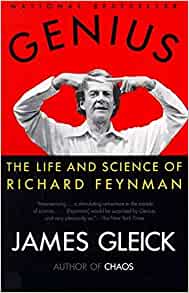
2022-12-05-Genius by James Gleick
ISBN: 0-679-40836-3 Dec. 5, 2022 Reading a book about Richard Feynman is always a risky proposition. You never know if what you are reading is actual history, embellished history, something Feynman invented as a kind of legend, or some combination of all the above. It…
Continue reading...